

Tesla Home Energy
Tesla Wall Connector with Powerwall: Planning the System
Plan a Tesla Wall Connector and Powerwall together by defining backup goals, charging priorities, electrical capacity and commissioning responsibilities.
This article is general education, not electrical design or do-it-yourself instructions. A qualified professional must assess the property and applicable requirements.
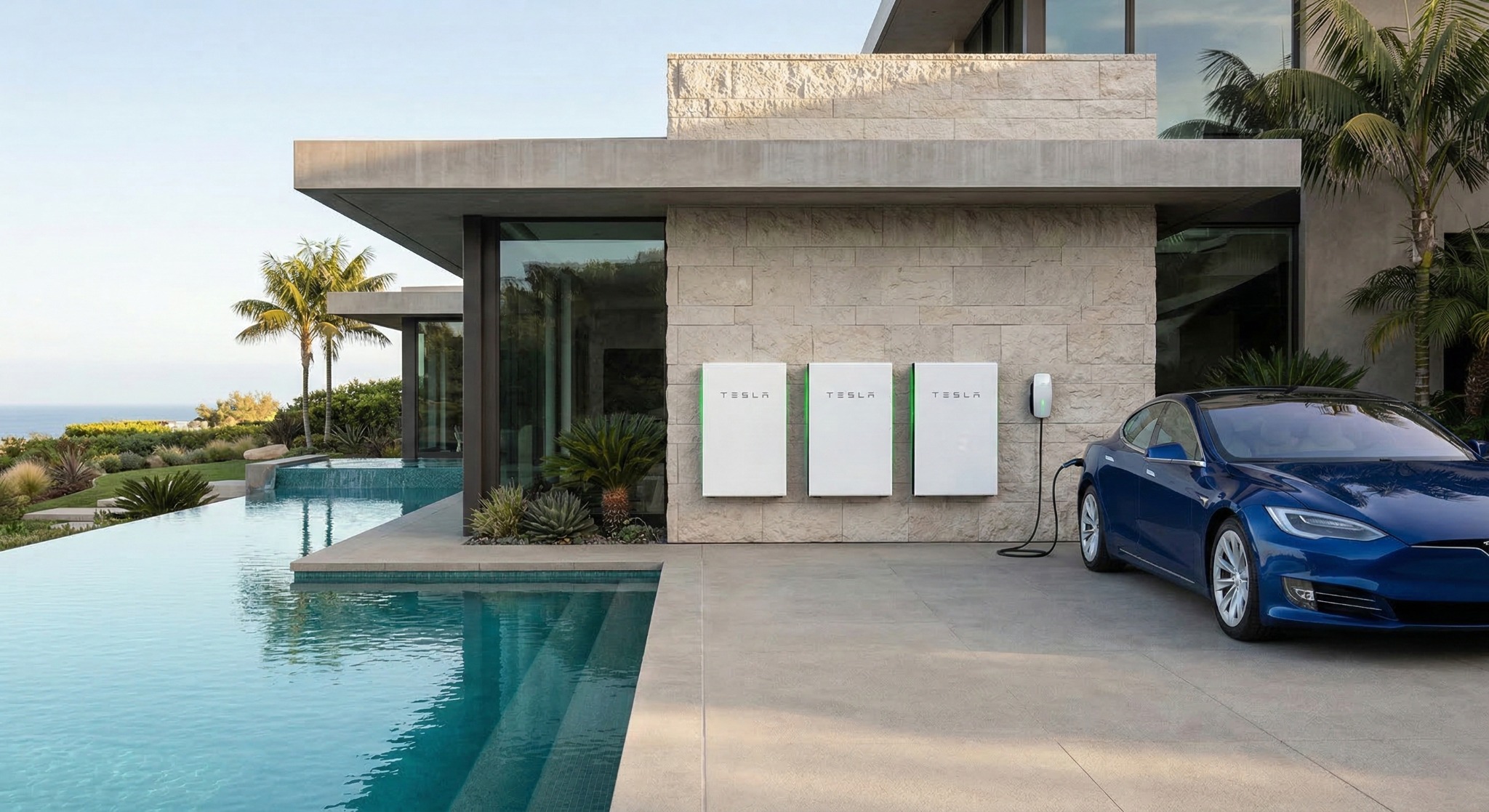
A Tesla Wall Connector and Powerwall can participate in one home-energy system, but they perform different jobs. The Wall Connector supplies the vehicle. Powerwall stores energy and can support approved home loads. Solar may produce energy, while gateway or backup-interface equipment coordinates the system’s relationship with the grid. Planning begins by defining how these pieces should behave on an ordinary day and during an outage.
Avoid choosing battery quantity from the size of the vehicle battery or assuming the car will always charge during backup. Household loads, solar production, reserve settings, equipment compatibility and controls determine the actual result.
Describe three operating scenarios
Write a short scenario for a normal grid-connected night, a sunny grid-connected day and a multi-hour outage. For each, state whether the Tesla needs to charge, which home loads matter and what energy source is expected to supply them. These narratives give the designer more useful direction than “whole-home Tesla system.”
On the grid, the priority may be off-peak charging or solar self-consumption. During an outage, the priority may shift to refrigeration, communications, medical equipment or climate control. EV charging can consume substantial stored energy, so decide whether it is essential, discretionary or disabled in backup conditions.
Add a departure constraint when relevant. A household that needs the car ready for emergency travel may accept limited outage charging, while another may preserve every available kilowatt-hour for the home.
Map the electrical architecture
Ask the installer to show the service, main panel, backed-up boundary, Powerwall, gateway or backup interface, solar inverter, Wall Connector and metering on a one-line diagram. The drawing should reveal whether the charger is inside or outside the backup boundary and which controls influence it.
A whole-home label does not explain simultaneous-load limits. Likewise, a selected-load panel does not show whether a particular charger circuit is included. The diagram and written operating description should agree.
Record equipment generations and models. Compatibility between batteries, gateways, inverters, metering and chargers should follow current Tesla documentation. Similar-looking products cannot be assumed interchangeable.
Decide how EV charging behaves during an outage
Powerwall energy is finite. A charging vehicle can shorten home-backup duration considerably, especially when solar production is low. Ask the designer to model one or two charging examples with stated home loads and reserve targets.
Tesla may support coordinated charging behavior in compatible systems. Confirm the current prerequisites and limits rather than relying on a video from another hardware generation. The proposal should identify the equipment and settings that provide control.
Homeowners also need a manual operating plan: how to pause vehicle charging, recognize backup status and protect the desired reserve. App automation is helpful, but the household should understand the underlying priority.
Size Powerwall from home priorities
Battery design requires both energy and power analysis. Energy relates to how long selected loads can operate. Power relates to which appliances can start or run together. Large motors, heating equipment, cooking and vehicle charging can create demanding combinations.
Collect interval usage data if available and list critical circuits. Discuss seasonal HVAC demand and well or sump pumps. A monthly bill alone does not show peak power or the timing needed for backup design.
Ask the proposal to state assumed loads and an estimated scenario rather than guarantee runtime. Weather, occupant behavior, battery reserve, solar and system losses change the result.
Evaluate the Wall Connector circuit independently
Even in a combined project, the charging circuit needs its own route, protection, mounting and capacity review. Solar or Powerwall does not remove branch-circuit requirements. The electrician should state circuit rating, configured output and cable route.
The best charging rate still comes from daily driving and dwell time. If home service capacity is constrained, discuss Tesla-supported power management or a moderate output before assuming a service upgrade is necessary.
If a second EV is expected, show its parking position and schedule. Power sharing may be useful on the grid, while backup behavior needs separate definition.
Coordinate solar production and Charge on Solar
When solar is present, compare production with vehicle presence and home demand. Charge on Solar requires supported Tesla products and current configuration. Ask how the system measures surplus and what happens when clouds or household loads reduce it.
Decide whether Powerwall should fill before the Tesla receives surplus, whether the vehicle has a minimum grid-charge target and how utility time-of-use periods affect the schedule. There is no single priority that suits every household.
For a new solar installation, include projected vehicle energy in the model while distinguishing annual offset from real-time charging. A large annual array total does not mean the car is home when the power is produced.
Assign responsibility across trades
A combined project may involve an electrician, Tesla-certified battery provider, solar contractor, utility and permitting authority. Identify the contracting entity and the party responsible for system design. If work is subcontracted, the customer should know who resolves integration issues.
The scope must assign permits, utility interconnection, equipment procurement, installation, commissioning and monitoring setup. Confirm current product-specific qualifications for both Wall Connector and Powerwall work; qualification for one product should not be assumed to cover another.
If existing solar will be modified, review its prior workmanship agreement. The new provider should document changes so later support is not divided by uncertainty.
Plan equipment locations as a group
Wall space can disappear quickly when batteries, gateway equipment, panels and a charger all compete for the garage. Review working clearances, structural mounting, environmental exposure, impact protection and cable paths together.
The Wall Connector should serve the parked vehicle without stretching its cable. Powerwall placement follows separate Tesla and applicable installation requirements. Do not force the battery into a poor location merely to keep all Tesla equipment visually grouped.
Communications also matter. Check Wi-Fi and any required wired paths after candidate locations are chosen. A communication plan should support commissioning without overriding safe equipment placement.
Commission the integrated system
Handoff should verify normal vehicle charging, battery operation, metering, solar display if present and the intended backup configuration. Ask the provider to demonstrate grid-connected and permitted backup behaviors using the approved commissioning process.
The homeowner should receive access to the Tesla app, an explanation of reserve settings, equipment status indicators and contacts for electrical versus product-support issues. Record Wall Connector current, battery configuration and the backed-up boundary.
Keep permits, final inspection, utility approval, one-line diagram, model and serial information and warranty documents. Screenshots are useful but should supplement formal records.
Use a written acceptance checklist
Before final payment, compare the completed installation to the design. Check equipment quantity and model, mounting, circuit labels, restored surfaces, app assets, permit status and promised documentation. Resolve open correction notices.
Ask who monitors or responds if one Tesla product works but another does not appear correctly in the app. A combined system needs an escalation path that does not leave the homeowner acting as coordinator between providers.
Finally, review future expansion. Additional batteries, solar or a second Wall Connector may require new design and approval. The current documentation should make that review possible without guessing.
Set a reserve policy the household can follow
Choose ordinary, storm-watch and active-outage reserve strategies with the installer. Ordinary settings may balance daily energy goals, while an approaching severe-weather event can justify preserving more stored energy. Active-outage behavior should identify which home loads and vehicle charging are deferred as the battery reaches household-defined thresholds.
Write the strategy without relying entirely on automation. Note where reserve is viewed, who may change user settings and which electrical configuration values remain installer-controlled. Include a departure exception: if the Tesla must be ready for essential travel, specify a limited energy target and the home loads the household agrees to conserve.
Review the plan seasonally. Cooling, heating and solar production can change the tradeoff between mobility and backup duration. A winter plan copied from a mild spring day may be unrealistic. Updating household behavior does not require redesigning the system, but any change to equipment ratings, backup boundaries or control hardware requires professional review.
During orientation, have another adult explain the policy back to the installer. This reveals whether app screens, controls and priorities are truly understood. Store the final one-page policy next to emergency contacts, not inside an account only one person can access.
Frequently asked questions
Can Powerwall charge a Tesla during an outage?
Potential behavior depends on system design, stored energy, solar, loads and supported controls. Ask the installer to document the proposed operation.
Should the Wall Connector be backed up?
That is a household-specific design decision. Consider reserve priorities, system power and whether outage charging is actually needed.
How many Powerwalls are needed for one Tesla?
Vehicle ownership alone cannot determine battery quantity. Size storage from home loads, backup duration, solar and desired charging behavior.
Does solar automatically make EV charging free?
No. Equipment cost, production, home consumption, charging time and utility rules affect the economic result.
Can one company install everything?
Possibly, if it has the required current qualifications and local availability. Confirm responsibility for every electrical, solar, product and utility task in writing.
Request a coordinated assessment
Review Tesla Wall Connector installation, Tesla Powerwall installation or request service. Final scope and qualified-provider availability are confirmed for the property.
Sources
Request a property-specific assessment
Share the address, equipment and project goal. The service team can confirm the next step and proposed provider qualifications.
More from the learning center
Continue reading.
Related guides for the next decision.
Adding Powerwall to an Existing Solar System
Evaluate inverter compatibility, array details, utility rules, monitoring and backup goals before adding Tesla Powerwall to existing rooftop solar.
Read the articleCommercial Tesla Charging Installation Planning
Plan commercial Tesla charging around users, dwell time, site power, parking, networking, accessibility, ongoing operations and future expansion.
Read the articleEV-Ready New Construction for Tesla Charging
Design an EV-ready home with practical conduit, panel space, parking layouts, load planning and flexible options for Tesla or multi-brand charging.
Read the article