

Tesla Home Energy
Tesla Wall Connector Planning for Cybertruck and Other Tesla Vehicles
Plan a Tesla Wall Connector for Cybertruck or another Tesla by checking vehicle capability, parking geometry, cable reach and home capacity.
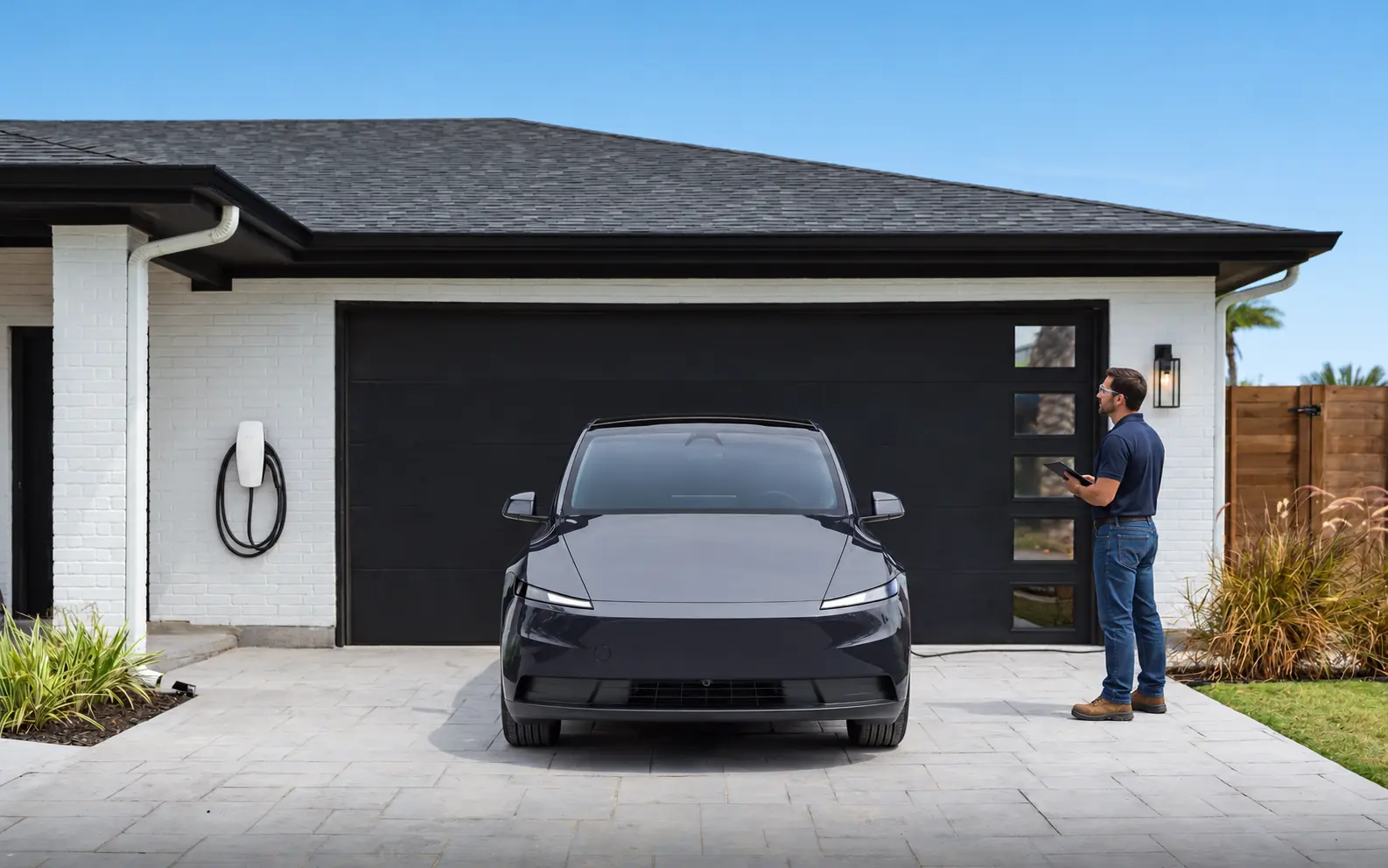
This article is general education, not electrical design or do-it-yourself instructions. A qualified professional must assess the property and applicable requirements.
Cybertruck brings the same fundamental home-charging questions as another Tesla—how far the household drives, how long the vehicle is parked and what the home electrical system can support—but its physical size and use can change the answers. Garage depth, parking direction, charge-port position, towing and outdoor parking deserve attention before a Wall Connector location is selected.
Plan from the exact vehicle and current Tesla documentation. Charging specifications and supported features may differ by model or product generation. A qualified installer should connect those facts to the property rather than copying a design from another garage.
Measure the parking arrangement with the truck present
Park Cybertruck where it will charge. Open doors, tailgate and garage door, then walk the normal route into the house. Check clearance around shelves, tools, bicycles and other vehicles. A technically reachable charger can still be inconvenient if the cable crosses the path or the connector is blocked by an open door.
Record whether the truck is pulled in, backed in or sometimes left in the driveway. If towing equipment or a trailer changes the parking position, show that arrangement too. The everyday charging location should work without unusually precise parking.
Do not judge cable reach by a straight line through the vehicle. The cable must follow a practical path from its storage position to the charge port without being stretched, crushed or driven over. Let the installer confirm the cable length for the selected product.
Compare indoor and outdoor locations
An indoor wall may simplify mounting and protect the equipment, but a driveway location might better match how a large truck is used. Evaluate weather exposure, drainage, sunlight, snow storage, landscaping and vehicle impact. Outdoor installation needs the product and wiring method appropriate to the environment.
A pedestal or freestanding structure adds foundation, routing and protection questions. If trenching crosses a driveway or yard, assign utility locating, excavation, inspection and restoration. Identify whether the property owner, electrician or another contractor is responsible for each task.
Consider security and cable storage. Equipment placed near a public sidewalk or shared drive may need an operational plan different from a charger inside a private garage.
Use the vehicle’s actual AC charging capability
Tesla publishes charging information for its vehicles. The branch circuit, Wall Connector setting and Cybertruck’s onboard AC charging capability all constrain the session. A larger home circuit does not guarantee a faster result beyond the vehicle’s supported limit.
Ask the installer to identify the current Tesla source used for the design and to state the proposed circuit and configuration. Avoid estimates based on another Tesla model or an older table. Product capabilities can change, and DC fast-charging rates do not describe home AC charging.
Translate capability into daily use. A household may need to replace only part of the battery’s capacity after a normal day. Overnight dwell time can make a moderate configuration practical even for a vehicle with a large battery.
Account for towing and high-energy days
Towing, payload, speed, terrain and weather can increase energy consumption. Instead of designing around an abstract full refill, identify the most demanding recurring day and how much time the truck has at home afterward.
For rare trips, public fast charging may complement home charging. For frequent towing or commercial use, a shorter home window may justify a different configuration. The owner should describe actual operations rather than expect the installer to infer them from the vehicle name.
Keep estimates qualified. The electrical installation can deliver a documented charging power, but it cannot guarantee miles added because driving efficiency remains outside the installation itself.
Assess the service and household loads
Cybertruck’s battery size does not by itself determine whether the home needs a panel upgrade. The electrician should evaluate the proposed charging load alongside HVAC, water heating, cooking, dryers, pool equipment and other loads using the applicable method.
Ask what supports any service-upgrade recommendation. Depending on the property and current products, alternatives may include a lower Wall Connector setting or compatible dynamic power management. Only the responsible professional can confirm whether an option is suitable and accepted for the project.
Panel space, equipment condition and service capacity are separate issues. A subpanel may address physical circuit space but does not create additional service capacity. The proposal should explain which issue it solves.
Decide who else may use the charger
If the home has another Tesla, compare both charging ports, schedules and capabilities. One charger may be shared by moving the cable, while two Wall Connectors may use a supported power-sharing design. The choice depends on parking convenience and charging windows as much as electrical power.
If a non-Tesla EV is likely, review the current Universal Wall Connector and compatibility information. Connector standards and vehicle support are evolving, so select equipment for the known vehicle mix and verify manufacturer guidance.
Avoid assuming an adapter solves every physical or electrical compatibility question. Ask how each vehicle will connect, authenticate if applicable and fit in the parking layout.
Get the physical route into the quote
For a large vehicle, charger location can influence route cost. Ask the estimator to mark the mounting point and electrical path on photographs or a plan. Identify visible raceway, wall penetrations, attic or crawlspace access and finish repair.
Exterior paths may need trenching, directional boring or pavement work. Do not accept a base price that excludes the most likely route without showing the alternative. If the final route depends on exploratory access, include an allowance and written change procedure.
Confirm Wall Connector supply, mounting hardware, protection, permits, commissioning and inspection. Product warranty and installer workmanship terms should be provided separately.
Verify the finished installation with real parking
During handoff, park Cybertruck in its normal position and connect it. Check that the cable reaches without tension, the connector can be returned to its storage point and walking paths remain clear. Confirm the configured current and circuit label.
Complete Tesla’s current connected setup and save product records. A working app does not replace electrical testing, but it can help confirm configuration and future monitoring. Retain permit closure and safe photographs of the route.
If charging performance later appears different, consider vehicle settings, battery condition, temperature, shared power and scheduled charging before changing electrical equipment. Use the installer and Tesla support channels appropriate to the symptom.
Build a quote around the real use case
A useful proposal identifies the Tesla model, Wall Connector model, branch circuit, configured current, route, mounting and any controls. It also states who supplies equipment, obtains permits, restores finishes, commissions the unit and responds after handoff. If Powershare or home backup is discussed, those components and responsibilities should appear as a distinct scope.
Compare quotes using the same parking position and daily-driving assumption. One bidder may be solving for ordinary overnight charging while another assumes maximum recovery after towing. Ask both to show expected charging energy within the actual time window, then decide which goal reflects the household.
Provider availability and Tesla product qualifications must be confirmed for the address and work requested. General electrical experience does not automatically establish current qualification for every Tesla energy product.
Keep a photograph of the parked truck connected at handoff. It documents the intended cable path and gives future household members a simple reference for safe storage and parking.
Add the towing use case to the home records so a later charger adjustment is evaluated against evidence rather than vehicle size alone.
Frequently asked questions
Does Cybertruck need a special home charger?
Use Tesla’s current guidance for the exact vehicle and desired features. Ordinary AC charging and bidirectional home-energy features may require different equipment.
Should Cybertruck get the largest possible circuit?
Not automatically. Base the circuit on vehicle capability, regular energy use, parked time and available home capacity.
Can the Wall Connector be outdoors?
Tesla provides product installation requirements. The installer must use equipment and methods suitable for the exposure, mounting and local conditions.
Can one charger serve Cybertruck and another Tesla?
Potentially. Check cable reach, schedules and current connector compatibility. Two units with supported power sharing may be another option.
Does installing a Wall Connector enable vehicle-to-home backup?
Do not assume it does. Ask for Tesla’s current supported architecture and all required equipment for bidirectional or backup features.
Request a Tesla charging assessment
Review Tesla Wall Connector installation or request service. Confirm current qualifications, product support and provider availability for the address.
Sources
Request a property-specific assessment
Share the address, equipment and project goal. The service team can confirm the next step and proposed provider qualifications.
More from the learning center
Continue reading.
Related guides for the next decision.
Adding Powerwall to an Existing Solar System
Evaluate inverter compatibility, array details, utility rules, monitoring and backup goals before adding Tesla Powerwall to existing rooftop solar.
Read the articleCommercial Tesla Charging Installation Planning
Plan commercial Tesla charging around users, dwell time, site power, parking, networking, accessibility, ongoing operations and future expansion.
Read the articleEV-Ready New Construction for Tesla Charging
Design an EV-ready home with practical conduit, panel space, parking layouts, load planning and flexible options for Tesla or multi-brand charging.
Read the article